Thursday, 1 November 2018

1 November 2018 - Swale Club Championship - Round Six

Swale Club Chess Championship - Round Six
Thursday 1 November 2018
White: Keith Nevols (163) - Black: Keith Hyde (162)
Sicilian Defence

After three defeats in my last four games, there are probably better times to then play the club champion. We enter the Closed Sicilian.

1. e4 c5
2. Nc3 Nc6
3. f4 g6
4. Nf3 Bg7
5. Be2 d6
6. O-O e6
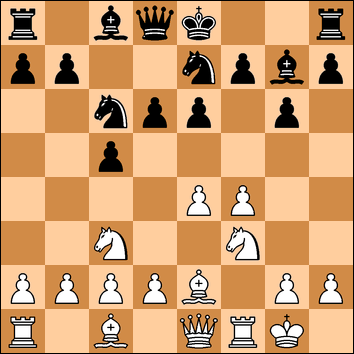
7. Qe1 Nge7

By placing the knight here, Black keeps the bishop diagonal open and can reinforce his d4 knight via c6. The downside is that it slightly weakens Black's force on the kingside.
Your Generated Chess Board

8. d3 O-O
9. Bd1 Nd4
10. Ne2 Nec6
11. c3

I like this set up. It expels the knight from d4, keeps the one on c6 out of range and I can relocate the bishop to c2 or d3. The downside is the slight weakness on the d3 square.

11. ......  Nxf3+
12. Rxf3 Bd7
13. Qg3

As my queen moved to her favourite spot, I was feeling comfortable, with a range of attacking plans.
Here the online engine recommends 13. ... Qb6 with an advantage to Black, meeting 14. Kh1 with 14. .. f5. Offering a pawn with 14. f5 could be met with 14. .. Ne5 or 14. .. exf5 15. Nf4 Be5.

13. .....   f5

But this is solid enough, preventing any ideas of a White f5. My reply is aiming to put pressure along the b1-h7 diagonal.

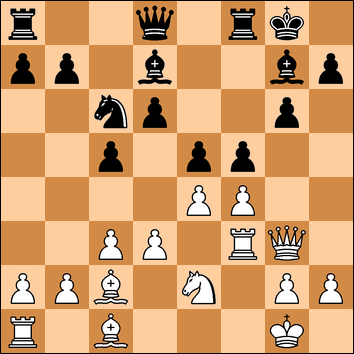
14. Bc2 e5
Your Generated Chess Board

Again the engine prefers 14. ... Qb6 or even 14. ... fxe4.

Now with pawns facing each other, things were getting complicated. I had just seen a YouTube video with GM Danny King, where he said that one thing he was always telling his students was not to release the tension. With this in mind, I tried to see what I could do here.

15. fxe5 Nxe5 16. Rf1 fxe4 17. Rxf8+ Qxf8 18. dxe4 looked solid enough but then Black's bishops are near good squares where they could create pressure. Or 15. .... Bxe5 16. Qf2 Bg7 achieves nothing and 15. ... Bxe5 16. Bf4 Qb6 is good for Black.

15. exf5 Bxf5 is poor and just leaves the d3 pawn weak.

I also considered 15. h4 but then 15. ... Bf6 16. h5 Bh4 17. Qh2 (not 17. Qh3?? fxe4) fxe4 18. dxe4 Bg4 19. hxg6 hxg6 20. Re3 and things are looking awkward with 20. .. Kg7! preparing Rh8.

Instead I decided to keep the tension, as advised, and improve the position of my bishop and rook.

15. Bb3+ Kh8
16. Rf1

To nullify the threat of fxe4. If 16. Rf2 then 16. .. Bf6 forces me to move the queen.

16. ...   Qe7

Black is also reluctant to ease the tension but plans to exchange off the bishops. 16. .. Qb6 is still an interesting move.

17. Bd5 Rc8
18. Bd2 Be6
19. Rae1 Qf7
20. Bxe6 Qxe6

The exchange of one pair of bishops reduces the fears either side had of opening up the position.

21. a3?!

The pawn on a2 has to be protected, but 21. b3 would have been a more accurate way of doing it. Black could now try 21. .. Qb3 with possible ideas of infiltration on the white squares.

21. .....   b5

With Black now thinking of opening up the queenside, I decoded to resolve a little tension.

22. fxe5

Black has four ways to recapture.
22. .... Bxe5 23. Bf4 Bxf4 24. Nxf4 Qb3 25.Rf2 is equal.
22. .... Nxe5 23. Nf4 Qb3 24. Bc1 is also equal.
(22. .... Qxe5 23. Bf4 loses a pawn).
Black chooses the fourth way .... 

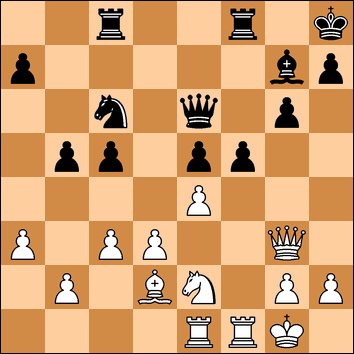
22. .......dxe5

....and offered a draw.
Your Generated Chess Board

My concern now was over the half open d-file and weak pawn on d3, and so,  being unable to see a way to make progress (and unwilling to risk a third consecutive defeat) I agreed.


Thursday, 25 October 2018

25 October 2018 - Swale Club Championship - Round Five

Swale Club Chess Championship - Round Five
Thursday 25 October 2018
White: Keith Nevols (163) - Black: Rob Woolacott (132)
Pirc Defence

1. e4 d6
2. d4 Nf6
3. Nc3 Nbd7
4. Nf3 g6
5. Bg5 Bg7
6. Qd2

My usual system against the Pirc defence, keeping open the options of castling either side and also attacking on the kingside.

6. .....  O-O
7. Be2

7. e5 dxe5 8. dxe5 Ng4 9. e6!? is an interesting pawn sacrifice. 9. .. fxe6 10. O-O-O with Bc4 to follow and Black might find it difficult to develop. An ides to keep in reserve.

7. ....  e5?!

7. ... c5 is more in the spirit of the opening. Now I could see a way to get an initiative.

Your Generated Chess Board

8. dxe5 Nxe5

If 8. .... dxe5 then I had a choice of 9. Rd1, 9. O-O-O or just 9. O-O.

9. Nxe5 dxe5
10. Qxd8 Rxd8
11. Nd5

Black could consider here an interesting exchange sacrifice in 11. ... Rxd5!? 12. exd5 Nxd5

11. ......  Rd6
12. Nxc7 Rb8

So I am a pawn up, but the e4 pawn is weak, my knight is slightly offside and my king has not yet castled. I sought to retrieve the knight with tempo to defend the e4 pawn. But Black has a cunning plan ....

13. Nb5 Rc6
14. Nc3

The computer recommends 14. O-O-O. Black cannot play 14. ... Nxe4 because of 15. Rd8+ Bf8 16. Bh6 (a point I had not noticed). Black has to play 14. ... Be6. If 15. Nc3 then 15. .. Rxc3 16. Bxf6 Rc6 17. Bxg7 Kxg7.

I never considered castling as I thought 14. Nc3 was good enough. It defends the e4 pawn and I can castle on the kingside the next move.

Your Generated Chess Board

14. ......... Rxc3!!

Wow! A shock that nearly blew me off the chair. A brilliant move. I gave a big thought as to how I could cobble together a defence.

15. Bxf6 Rxc2 did not look much fun but after 16. Bxg7 Kxg7 17. Rb1 Be6 18. Bc3 Rc5 19. a3 I am just about hanging on. There is a possible line 19. .. Rd8 20. Ke2 Bc4 21. Bxc4 Rxc4 22. Ke3 (not 22. f3?? Rc2+ and Rdd2) Rc2 23. Rhc1 and an exchange of rooks. Black would be better but perhaps not enough to win.

Instead I decided to trust in my defensive skills - not always a good idea.

15. bxc3 Nxe4
16. Be3

If 16. Bd2 Nxd2 17. Kxd2 Bh6+ 18. Ke1 Bf5 and I am under heavy pressure. I decide to let a pawn go to activate the bishop and try to get the other rook out.

16. ....  Nxc3
17. Bc4

This was to stop a Black Be6 and defend the a2 pawn as well as hopefully get the king to e2 and release the king's rook.

17. ....  b5
18. Bb3 a5
19. a3?

This was the position I had foreseen as move 15, but 19. Kd2 is a better defence.  19. .. e4 20. a4!? Nxa4 21. Bxa4 Bxa1 22. Rxa1 bxa4 23. Rxa4 and White should be able to round up the a5 pawn to get an equal position. Or if 19. ... Ne4+ 20. Ke1.

19. a4 is not possible as after 19. ... bxa4, White cannot play 20.Bxa4 due to 20. .. Nxa4 21. Rxa4 Rb1+.

19. ...  a4
20. Ba2 e4

Now if 21. O-O then 21. .. Nxa2 22. Rxa2 Be6 wins the exchange, but I should not have been concerned about this, as it would have been worth it to get rid of one of those bishops.

Your Generated Chess Board

21. Bd2 Bg4
22. h3 Nxa2
23. Rxa2 Be6

The difference now is that I cannot sacrifice the exchange, a whole rook looks to be taken.

24. c4 bxc4

The emergence of a passed pawn, as well as the win of a pawn, ensures the game is virtually over.

25. Rc2 c3
26. Bc1

Of course, 26. Bxc3 loses straight away to 26. ... Rb1+.

26. .....  Bc4!

A very good move stopping White from castling. 26. ... Rb1 is even better though threatening Bb3. There follows 27. O-O Bc4 28. Re1 Bd3 29. Ra2 Bh6 30. Bxh6 Rxe1+ 31. Kh2 Bb1 and White can resign.

27. f3

Have to get out somehow!

27. ........  Bd3
28. Kd1

Seeing that 28. Ra2 Rb1 and Bh6 was good enough, I at last decide to return the exchange.

28. .....  Bxc2
29. Kxc2 exf3
30. gxf3

Black is now two pawns up with several ways to win. My hope was that he would get confused by the wealth of winning moves, but no such luck. I thought if I could get that a4 pawn off the board I might have a chance.

Your Generated Chess Board

The rest of the moves do not need any comment. White's cause is hopeless.

30. ......  Re8
31. Kd3 Rb8
32. Re1 Rd8+
33. Kc2 Kf8
34. Re4 Rd4
35. Rxd4 Bxd4
36. Bf4 Ke7
37. Bc7 Bc5
38. Kxc3 Bxa3
39. Bg3 Bd6
40. Bf2 Ke6

The plan is clear. The a-pawn cannot be stopped by the bishop, and while the king goes over there, then the Black king will hoover up the kingside.

So it was time for White to resign. A very well played game by my opponent, and my third defeat in the last four.


Sunday, 21 October 2018

21 October 2018 - Stevenson - Hastings v Swale

Stevenson Cup - Hastings v Swale - Board One
Saturday 21 October 2018
White: Tobias Stock (183) - Black: Keith Nevols (163)
Dutch Defence

A tough opponent at the top of a tough club.


1. d4 f5

2. g3 Nf6
3. Bg2 e6
4. c4 d6
5. Nh3!?

Well, this is interesting. White develops the king's knight to the edge of the board to avoid blocking the bishop and perhaps thinking of coming to f4.

If 5. . e5 then 6. dxe5 dxe5 7. Qxd8+ Kxd8 8. Ng5 Ke8, White could castle or play 9. Nc3 and have a comfortable game .. or even 9. Ne6!? and already Black is on the back foot. 9. .. Bd6 10. c5 (10. Nxg7+ Kf7 traps the knight).

I rejected 5. .. e5 as I did not want to exchange queens and dislodge the king so early.

5. ....   Be7
6. b3

These sort of double fianchettos can be dangerous. With Bb2 this hinders any hope I may have had of playing e5.

6. ....  O-O
7. Bb2 Qe8
8. O-O Qh5

With the odd position of White's pieces I was keen to start an attack and g5 looked attractive -perhaps with f4 but also to keep his knight away from that square.. So I gave some thought to 8. .. Nh5 here, but decided for the queen instead as you know what they say about knights on the rim.

Calmer development with 8. ..Nbd7 or 8 ... c6 (planning to follow with d5 shutting out both white bishops) were other options.

Your Generated Chess Board

9. Nf4 Qh6
10. e3

10. h4 is another idea, hindering g5 and squeezing the queen's space.

10. ....  c6

Both to free the bishop of defensive duties on b7 and also to prepare d5 and try to limit the white bishops (although my bishop on c8 does not look too happy).

By now, we had both used up a lot of time. The limit was 35 moves in 75 minutes and then another 15 for the rest of the game. White had 33 minutes left for 25 moves and I had 36 minutes.

11. Nd2 g5
12. Nd3 Ng4

To provoke a weakness in front of the White king.

13. h3 Nf6
14. Qe2 d5

While White continued to develop, I have managed to get this move in to close the centre. I now planned to continue the attack.

15. f4 g4?

I had an eye on the g3 pawn but opening up the g-file with 15. .. gxf4 is better with 16. exf4 Qg7 and then Ne4, or 16. gxf4 Ne4.

16. h4 Nh5
17. Qf2 Nd7
18. Ne5

At this point, a double attack of chess blindness hit me. I had been looking at how I could make a tactic of Nxg3; Qxg3 Bh4 work - with Qh2 Bf2+, and thinking that White had to play Kh1 (whereas he can simply play Rxf2).

Even without the rook, Kh1 would have been good enough. But if I could then exchange queens, and play Rh6+ I would win material back. So I prepared to move the rook to the h-file.

18. .....Rf6?

Your Generated Chess Board

... and as I played the move I now noticed that the rook is blocking the bishop from h4. Black should play 18. .. Nxe5 and the game is still even.

I patiently waited for when I would be able to do this and play the rook back to f8 when ...

19. e4!!

.. stunned me. The move itself is not that great, but it was the psychological effect. Running low on time, I had to work out all sorts of complications.

Straight away I saw 19. .. fxe4 20. Nxg4 but then 20. .... Qg6 21. Nxf6+ Ndxf6 and although White is the exchange for a pawn ahead, Black's active pieces make good compensation. (The computer rates this as equal).

With 19. .. dxe4 I saw 20. Nxe4 with the same idea but after ...fxe4 21. Nxg4 Qg6 22. Nxf6+ Ndxf6, this time Black has a rook and a pawn for two pieces but is unable to defend the g-pawn.

I don't know what White was preparing after 19. .. dxe4. If 20. d5 trying to break open the diagonals then 20. .. Bc5 21. Bd4 Bxd4 22. Qxd4 Nxg3. More likely, 20. Nxd7 Bxd7 21. d5 cxd5 22.cxd5 exd5 23. Bxf6 Qxf6 and Black has two pawns for the exchange. Perhaps with both of us short of time, Black thought he could outplay me in this position.

But White's bluff worked. Instead of 19. .. dxe4 I went wrong.

19. .....  Nxe5?
20. dxe5 Rf8
21. cxd5 cxd5
22. exd5 Bd8

White has a clear win - he is a pawn up with a much better position. The only problem, from his point of view, is that he has just two minutes left for the next 13 moves.

23. Bd4 b6
24. d6 Rb8
25. Nc4 Qg7

Desperately trying to cover the holes in the queenside and seventh rank.

26. Rac1 Bb7
27. Ne3 Bxg2
28. Nxg2 Qb7

With this move, and with White entering his final minute for seven moves (and no increments), I decide to try a bluff of my own and offer a draw, which naturally White ignores.

Your Generated Chess Board

29. Rc3

Protecting the g3 pawn, preparing to double, and freeing the queen. Not bad for one move.

29. ....  Ng7
30. Qd2 Nh5

I am very low on time too.

31. Bf2 Ng7
32. Rfc1 Ne8

Definitely a back rank defence.

33. Ne1 b5
34. Nd3

Preventing the threat of Ba5.

34. ......  Bb6
35. Nc5 Bxc5

White reached the time control with eleven seconds left, and I had 2 minutes and forty seconds. White now borrowed my scoresheet to write down the moves he had missed and I surveyed the wreckage of my position. White just now needs to consolidate and finish off.

36. Bxc5 Qd7
37. b4 Rb7
38. Be3 Rf7
39. Rc6 Rb8
40. Qf2 Qb7
41. Qg2 Rd7
42. Kh2 h5
43. R1c3 Ra8
44. Ra3 Qb8

Your Generated Chess Board

45. Rb6! Qc8
46. Rxb5

And I played 46. .... Rb8 but decided to call it a day.

The whole match was a heavy defeat.

Hastings v Swale
Tobias Stock (183) 1-0 Keith Nevols (163)
Stephen Blewitt (162) 1/2-1/2 Keith Hyde (162)
James Wheeler (160) 1-0 Rob Woolacott (132)
John Kimber (142) 1/2-1/2 Tyrone Jefferies (119)
Adrian Cload (135) 1-0 Vytautas Gedminas (116) 
Marc Bryant (131) 1-0 Andrew Gillard (113)

Hastings 5-1 Swale

Thursday, 18 October 2018

18 October 2018 - Swale Club Championship - Round Four

Swale Club Chess Championship - Round Four
Thursday 17 October 2018
White: Barry Sawyer (91) - Black: Keith Nevols (163)
Dutch Defence

1. Nf3 f5

I have always thought 1. Nf3 to be an odd first move. Many years ago I used to reply with 1. .. Nc6 and then 2. d4 would take me into strange waters. Now I can just set up the Dutch.

2. g3 Nf6
3. Bg2 e6
4. d3

4. d4 is considered more aggressive to make it difficult for Black to play Nc6.

4. ....  Be7
5. c4 Nc6

The point is that, had White played 4. d4, then he could now play d5 to dislodge the knight and get space in the centre.

6. a3 a5

Not sure why White played a3 but a Black a5 is always a useful move to prevent queenside advances.

7. Bd2 O-O
8. O-O Qe8
9. Nc3 d6

Another reason why the White pawn should be on d4 is to hinder Black from playing e5.

Your Generated Chess Board

10. Nb5 Bd8
11. Bg5 Qh5

I gave a lot of thought to playing Qh5 or Qg6 but decided this was the more aggressive position.

12. Bxf6?! Rxf6

White has made a mistake - this exchange not only means that White loses his dark squared bishop but it also helps Black in the rook lift to put pressure against the White king. Something simple like 12. Re1, preparing e4, would have been better.

13. Qd2 Rh6

Forcing a weakness and allowing an attack to gather pace.

14. h3 e5!

The plan now is just to move pieces over to the kingside and see what happens. However I needed to sort out the queenside first. That knight can't be allowed to just sit there.

15. Nh2 Ne7
16. f4 c6!
17. Nc3 Bb6+

A great route to bring the bishop into the game.

18. e3

I had expected 18. Kh1 and wondered if White had any ideas of Rg1 and g4. The computer however agrees with White that this is the better move.

18. .....  Be6

I want to bring the other rook over. 18. .. Rg6 first would have been more accurate but I was constantly concerned over giving my pieces - in this case, the queen - a path of retreat should it become necessary.

Now if 19. Nf3 and although Black still has an edge, it is minimal.

Your Generated Chess Board

19. h4?

I am guessing White was concerned about a Black g5 but this is a weakness which allows Black to gather momentum.

19. ...  exf4

The fact that White has to capture with the rook opens some spaces for Black.

20. Rxf4

I had originally intended to play 20. .. Bc7 with the idea of d5, but now saw something better (after ruling out 20. .. Ng6?? 21. Bf3).

20. ....  g5
21. Bf3?

I had thought, as perhaps White did, that this was forced but in fact it is a mistake. 21. Rf2 would have lost a pawn but we have both overlooked something.

21. ..... Qg6?

We have both overlooked 21. .. gxf4 22. Bxh5 Bxe3+ 23. Qxe3  fxe3 and Black is the exchange and pawn up. However Black is about to bag the exchange anyway.

22. hxg5 Qxg5
23. Kg2 Ng6
24. e4 Nxf4+
25. Qxf4 Qxf4
26. gxf4 Kf7

I was confident that I just needed to consolidate by bringing the other rook into the game to bring home the point.

Your Generated Chess Board

27. Nf1 Rg8+
28. Ng3 Be3
29. Nce2 fxe4
30. Bxe4 Bg4
31. Bf3?

31. Rh1 but Black is still losing.

31. ....  Bh3+
32. Kh2

Your Generated Chess Board

32. ....  Kf8


I was so worried about a White Bh5, hence dropping the king out of range, that I did not see 32. .. Rh4! which forces checkmate by 33. Bg2 (the only move to stop Bf1 mate) Bf5+ 34. Bh3 Bxh3 35. Ng1 Bf1+ 36. Nh3 Rxh3++.

But I coast home the longer way.

33. Bh5 Bg4
34. Rh1 Bxe2
35. Kg2 Rxh5
36. Rxh5 Bxh5
37. Kh3 Bg4+
38. Kg2 Bxf4
39. Kf2 Bxg3
40. Kxg3 Be2+
41. Kf2 Bxd3
42. b3 h5

White resigned.

Wednesday, 10 October 2018

10 October 2018 - En Passant - Maidstone v Swale

En Passant Cup - Maidstone v Swale - Board One
Wednesday 10 October 2018
White: George Hollands (163) - Black: Keith Nevols (163)
French Defence

1. e4 e6

2. Qe2 c5

And so we go straight into a Closed Sicilian style opening.

3. Nc3 Nc6
4. f4?!

I am now thinking that, for this move order, I ought to answer with 4. Nf3 and think about pushing the f-pawn later. I was not worried about Black's next move as I thought the waste of time with my queen is balanced by the waste of time with the knight.

4. ...  Nd4

Black also has the energetic 4. ... d5 which I think I might have met with 5. Nf3.

5. Qd1 d5
6. Nf3 dxe4
7. Nxe4 Nf6
8. d3 Nxe4
9. dxe4 Nxf3
10. Qxf3 Bd7

Your Generated Chess Board

Black has initiated a couple of piece exchanges and a pawn exchange, and the position is equal. I thought that Black was preparing Bc6 with perhaps f5 to put pressure on the White centre, or perhaps just Be7 and then castling.

At this point, I had a long think. 11. Bd2 to come to c3 is one option. 11. Bd3 was also considered but I thought Black might meet it with 11. ... Qb6 and I was not sure how to meet that. (Probably 12. b3 and then Be3 is safe enough).

However I saw the possibility of attacking while the Black king was in the centre by way of a temporary pawn sacrifice. I examined all sorts of lines and moves but overlooked an obvious one.

11. f5? exf5
12. Bc4

This was the plan. I thought Black might play 12. .... Qe7 where I planned 13. O-O. I also looked at 12. ... Be6 with 13. Bxe6 fxe6 14. fxe5.

12. ....... Qh4+!

But this was a shock. I had not seen it at all. Now I knew I was lost. 13. g3 Qxe4+ 14. Qxe4 fxe4 and Black is a strong passed pawn up for nothing. Instead I try another line to get the king to safety and stay in the centre.

13. Kd1 O-O-O
14. Bd2 f6?!

14. .. fxe4 is much stronger. White has to play 15. Qg3 and Black has 15. .. Qf6 16. Kc1 Bd6 or 16. c3 Be6 and the game is almost over.

15. Bd5

So I manage to eliminate the centre and stay in the game for a few more moves.

15. ....  fxe4
16. Qxe4 Qxe4
17. Bxe4 Bg4+
18. Kc1 Bd6

If I can get both rooks into the centre then, with a 3v2 down on the kingside, I have a chance of hanging on.

19. h3 Bd7
20. c3 Be5
21. Be3 b6

Your Generated Chess Board

I ought to play Kc2 and find some secure outposts for those bishops. Instead, I am still reeling from the shock of Qh4+ (poker players call it 'playing on tilt') and, distracted by the prospect of a counter attack against the black King, made a hopeless blunder.

22. a4 Bc7
23. a5??? Rhe8

Of course! The game does not last much longer.

24. axb6 Bxb6
25. Bxc5 Bxc5
26. Bxh7 Re2
27. Resigns

One of my worst games ever. I take the lesson that tactics and gambling on attacks are not my king, as there is always a line which I overlook and which my opponents nearly always find. I resolve to always ensure that my pieces and development are safe, especially when I am up against strong opposition.


Maidstone v Swale
George Hollands (163) 1-0 Keith Nevols (163)
David Heath (146) 1-0 Keith Hyde (162)
Barrington Beavis (143) 1/2-1/2 David Page (141)
Peter Dirmauskas (135) 1-0 Rob Woolacott (132)
Ian Clark (125) 1/2-1/2 Tyrone Jefferies (119)
Douglas Smith (117) 1/2-1/2 Vytautas Gedminas (116)

Maidstone 4.5-1.5 Swale

Thursday, 27 September 2018

27 September 2018 - Swale Club Championship - Round Three

Swale Club Chess Championship - Round Three
Thursday 27 September 2018
White: Keith Nevols (163) Black: Tyrone Jefferies (119)
French Defence

I entered this game in a low mood after the disappointment of the previous week.

1. e4 e6
2. Qe2

My standard anti-French. The idea is that if Black plays 2. .. d5 (as French players usually do) then after 3. exd5 he has to re-take with the queen. It is not dangerous for either side at all but often positions move into a closed Sicilian (after Black plays c5) which suits me.

2. ....  a6

In this game, my opponent decides to play the St George's Defence, a system made famous by Tony Miles defeating the then world champion Anatoly Karpov in 1980.

3. Nc3 b5
4. f4 Bb7
5. Nf3 Ne7
6. d3 Ng6?!

I think this is a strange place to put the knight - just asking for f5 at some point. Indeed I could play it now - 7. f5 exf5 8. exf5+ Ne7 9. Ne4 - but wanted to ensure my king was safe first and I had some pieces developed. Having a rook on f1 might be useful too.

7. g3 Bb4
8. Bg2 d6
9. O-O Nd7

Your Generated Chess Board

Castling on either of the last two moves would have been better for Black. Now I have the chance to create the initiative I mentioned earlier.

10. f5 Nge5

If 10... exf5 11. exf5+ Ne7 White could keep up the pressure with 12. Nd4 Bxg2 13. Kxg2 Ne5 14. Bg5 and Ne4.

11. fxe6

After 11. ... fxe6 I was planning 12. Ng5. (12. Bg5?? loses to 12. .. Nxf3+)

11. ..... Nxf3+?

But this loses a pawn and weakens the Black kingside.

12. Qxf3 Nf6
13. exf7+ Kxf7

I now had a big think to see if there was any way to build up on this. The computer's recommendation is 14. Be3 but I decided to pressure on f6.

14. Bg5 Rf8!

Good defence. Planning to castle artificially. I examined 15. Bxf6 gxf6 16. Qh5+ Kg8 but there is nothing there. The computer considers 15. d4 calmly improving to be best.

Instead I opt to force the exchange of a Black bishop while limiting the scope of the other one.

15. Nd5 Bxd5
16. exd5 Bc5+
17. Kh1 Kg8

Black has solved the problem of his king but White has the two bishops and a beautiful square on e6 which one bishop now heads for.

18. Bh3 Qe8
19. Rae1 Qg6
20. Be6+ Kh8

And now I draw a blank. Black has defended well and I need to do something with that g5 bishop. Learning from my mistake last week I decide to exchange some pieces off and try to outplay my opponent in the ending.

However 21. Bd2 is best here planning to relocate to c3. There are no useful discovered attacks from Black moving the knight on f6.

Your Generated Chess Board

21. Bxf6?! Rxf6

For some reason I only considered 21. .. Qxf6 where I planned 22. Qxf6 to isolate a black pawn on f6.

22. Qd1 Raf8

And now I thought I was in danger of losing the game, although there are no immediate threats. My mind was on how I could isolate the black bishop out of the game but here 23. d4 loses at once to 23. .. Rxf1+ 24. Rxf1 Qe4+.

23. Rxf6 Qxf6
24. c3 Bb6

24. .. Bf2 was worth a thought. 25. Rf1 Qe7 26. Qe2 Be3!

25. d4

Mission accomplished. Now if I can keep the bishop tied up over there then effectively I am a piece up.

25. .....  b4
26. Bh3

Planning more exchanges down the f-file.

26. ... g6
27. Rf1 Qe7
28. Rxf8 Qxf8

Your Generated Chess Board

29. Qe2 bxc3
30. bxc3 a5?!

This surprised me. I had expected 30. .. Ba5. (31. Qxa6? would allow 31. .. Qf3+ and a chance for a draw).

31. Kg2 Kg7
32. Be6 Qf6
33. a4

The bishop is shut in. So the plan .... advance on the kingside, tie Black down, exchange queens, exploit with the king. Easier said than done.

33. ... Kf8
34. h4 h6
35. h5

35. Qe1 and g4-g5 might have been a better idea. As played, the Black pawns end up on Black squares and are not so easy for the bishop to attack.

35. ...  g5

Black could have played 35. .. gxh5 36. Qxh5 c5 to try to free the bishop.

36. Qf3 Kg7
37. Qe4

I did not like 37. Qxf6 Kxf6 - although the White king might be able to exploit through c4-b5.

37. .....  Ba7
38. Bg4 Bb6
39. Qe8 Qf7
40. Qe4

Change of mind. I decide to hold off the queen exchange until my king is further forward.

40. ... Ba7
41. Bf5 Qf6
42. Kh3 Bb6
43. Kg4 Qf7
44. Bg6 Qf6
45. Qe8 Qf8
46. Qd7+ Kf6

Now down to the last five minutes I stopped writing down the moves.

Your Generated Chess Board

I was not confident that exchanging queens would win - Black had enough to defend and stop the White king getting through. What I needed to do was force a queen exchange with my queen on e6 to change the pawn structure. This I managed to do - with bishop on f5, queen on e6 and the Black king on f6 and queen on e7 - forcing Qxe6; dxe6 and my pawn was on e6.

Black freed his bishop and White was able to infiltrate the king to the kingside and take the pawns on h6 and g7. Advancing the pawn to h7 kept the Black bishop occupied, the pawn on e6 kept the king busy, so that left the queenside.

I advanced my king over to the queenside, captured on a5, and advanced forcing the win of the bishop. With just the centre pawns left, I got the king to c7 where the d-pawn could be nursed home. This is when Black resigned.

Not an easy win but I was glad to get the full point.


Thursday, 20 September 2018

20 September 2018 - Swale Club Championship - Round Two

Swale Club Chess Championship - Round Two
Thursday 20 September 2018
White: Vytautas Gedminas (116) - Black: Keith Nevols (163)
Scandinavian Defence

1. e4 d5

For the benefit of new readers, this is my favourite defence to e4. It is an unambitious but solid defence and I have a very good record with it.

2. exd5 Qxd5

2. ... Nf6 is the other common response.

3. Nf3 Nf6
4. Nc3 Qa5

And this is my favourite place to put the queen. Qd8 is also playable. Some people like Qd6.

5. Be2 Bf5

During the game I was trying to think of what should I play after 6. Nd4 e6 7. Nb3. Probably Qb6. The queen getting pushed around is balanced by the waste of time with the knights.

6. d3

White has chosen a quiet development. Bc4 and d4 is the main line.

6. ....  c6
7. Bd2 Qc7
8. Nd4 Bg6
9. Bg5 Nbd7

Your Generated Chess Board

10. Bg4!?

A deployment of the bishop I had not seen before. 10. Bf3 might be stronger but I think simply 10.O-O is best. I now saw a way to grab the initiative.

10. ....  Qe5+
11. Be3 e6

Planning to complete development with Bc5 as White's pieces are currently somewhat not well placed.

12. Qf3?

Marks for aggression but this is a wasted move. Again castling is best. I could now see how to place some pressure on the centre with the hope of winning a pawn.

12. ......  Bc5
13. Nde2

I analysed 13. Nce2 to see if I could get anywhere with 13. .. Bb4+ but 14. c3 seemed secure enough. (14. Bd2 would be a blunder after 14. .. Bxd2 15. Kxd2 Qg5+), so 13. .. Nd5 would keep the pressure on. Now I can force the win of a pawn.

13. ....  Bxe3
14. fxg3 Nxg4
15. Qxg4 Qxe3

Your Generated Chess Board

So it was time to think of strategy - and I made what I think is the wrong strategic decision.

With all respect to my opponent, I am the better player and so I now think, should I get the queens off, go into an ending a pawn up, and be confident that I can outplay him with simple chess? Against this argument is the fact that a pawn lead is not enough to win, and my bishop on g6 is not that well placed - the pawn on d3 both blocks and limits its expansion.

I could keep the queens on, try to keep his king in the centre, and go for an attack. Against this argument is the fact that a tactical battle can go both ways, and I usually run short of time (as I do here) and thus risk losing the game.

After umm-ing and ah-ing, I opt for keeping the queens on.

16. Qb4 O-O-O

With reference to my last note, I think I should have considered 16. ... Qb6.

17. Qa5

I considered here 17. .. Ne5 but did not like 18. Nd1 (however 18. .. Qg5 is fine) and 17. ... Nc5 (which I rejected because of 18. b4 Nd7 and, at some point, b5 taking an initiative).

The computer also suggests 17. .. h6 to give the bishop a retreat square. I did not consider this. Caution won the day.

17. ....  Kb8
18. Nd1 Qh6

Now I should have played 18. .. Qb6 or 18. ... Qe5 and let White decide if he wants to exchange. The queen has to go to the only possible square to avoid an exchange.

19. O-O

This move surprised me - although it is obvious really. I just did not think he would castle in front of my queen.

19. ....  Nf6

19..... b6 is an option to force the White queen off the fifth rank. White could play 20. Qc3 Kb7 21. Nd4 Rc8 or 20. Qe1 Qg5. I just wanted to activate the knight.

20. Qe5+ Ka8
21. h3?!

An inaccuracy as White did not foresee my next move.

21. ..... Qd2

After a long think. White's next move is obvious but I was looking at the position after.

22. Rc1

White could also try 22. Nd4, where 22. .. Rd5 23. Qe2 Ne4!? is quite pretty (23. Qf4? Qxf4 24. Rxf4 e5). But 22. Rc1 was the move I expected.

Your Generated Chess Board

I had tried to examine whether either 22. ... Be4 or 22. .. Ne4 were any good. After 22. ... Be4 White could play 23. Rxf6 gxf6 24. Qxe4 and have two knights for a rook and a pawn (I did not see that Black could play 23. .... Bxd3! 24. cxd3 gxf6 and then take the pawn on d3 which would leave White with two knights for a rook and three pawns). And after 22. ... Ne4 White could play 23. Ndc3 and that comes to nothing.


The best move, which I did not consider, is 22. .. Nd5! exploiting White's lack of co-ordination. Then 23. Rf2 f6 with e5 to follow, and the bishop will have some squares to go to f7, hit a2 and perhaps come to d5.

The move I played seemed the most natural to me.

22. ....   Rd5
23. Qe3 Qa5

In my big think referred to, I also looked at 23. .. Qxe3 24. Nxe3 Re5 25. Rf3 and tried to see if I could exploit White's shakiness. I saw 25. ... Bh5 26. g4 Bg6 but did not see the idea of following this up with h5.

Instead I decided, once again, to keep the queens on.

24. Nec3 Re5

If 24. .. Rg5 then 25. b4 and Black must exchange queens with 25. ... Qb6.

25. Qg3 Nh5

I wanted to try to get pieces closer to the king and to focus on the g3 square. Also if 26. Qf2 then I intended to swap off a rook with 26. .. Rf5 and bring in the other one via d8.

26. Qh4 Qc7?

Poor. As I said I was focusing on the g3 square but this weakens my hold on the fifth rank and allows White to take pot shots at the rook. Retreating with 26. .. Nf6 is an improvement.

27. d4 Ra5

27. .. Rf5 28. Rxf5 exf5 and my bishop looks rather silly. 27. .. Qb6 28. Na4 Qb4 29. Ndc3 and White is improving fast.

28. a4 Nf6

28. ... Qd8 offering to exchange queens is better but this move makes a space for the rook.

29. Ne3 Rh5
30. Qf2 Rd8

Bringing my final piece in. Although I could not see a clear way to win, this seemed natural.

31. Ne2 Ne4
32. Qe1 Rg5
33. c3 Ng3

This was the point of the last few moves. I wanted to occupy the g3 square and try to build up something around it.

34. Nxg3 Rxg3?!

Black should have taken back with the queen.

Your Generated Chess Board

35. Qe2

Missing 35. Ng4! with the threat of Ne5 cutting off the defence of the rook.
Black might have to play 35. .. Re8 (preparing f6) and then 36. Ne5 Rg5 37. g4 h5 38. Qe3 f6 39. h4 and Black will have to give up the exchange.

35. ....   c5

Aiming to open up the centre to find more spaces for my pieces.

36. Rcd1 cxd4
37. cxd4 Rg5

I am running out of ideas of what to do!

38. Nc4?

This is a mistake ....

38. .....  Qg3?

..... and I overlook 38. .. Rgd5. White can save the pawn with 39. Na3 a6 40. Qf2 but then Black can add pressure with 40. .. Qa5 or 40. Qb6.

39. Rf3 Qc7
40. Rc3!

Now it is White who has the better placed pieces and he quickly whips up a dangerous initiative.

40.     Qd7
41. Ne5 Qd5

I ruled out 41... Qxa4 as I did not like 42. Ra3. But then 42. ... Rxe5! wins at once.
Better for White would be 42. b3 where, two pawns down, he still has chances against the king and of trapping the black rook.

42. Rc5 Qe4

I finally decided to exchange queens, both to liberate the bishop and to reduce White's attack.

43. Qxe4 Bxe4

Your Generated Chess Board

Here the computer recommends 44. Re1! where 44. .. Bxg2 can be met by 45. h4 forcing 45. .. Rxe5 (45. ... Rg3 46. Kh2), or 44. ... Bg6 45. Nxf7 or 44. .. f5 45. g4.

44. g4 h5?

44. .. f6 is best where the game is then equal.

45. Nxf7 Rxc5
46. Nxd8 Rc2
47. Nxe6 hxg4
48. hxg4 Rg2+
49. Kf1 Rxg4

This was the position I had foreseen at move 44. But I underestimated the strength of the White d-pawn which will now put White in a winning position.

50. d5! Kb8
51. d6 Bc6
52. d7 Bxd7
53. Rxd7 a6

And now 54. b3 Rb4 55. Nb5 should win for White.

54. Rxg7 Rxa4
55. Nc5 Rb4
56. b3 Rb5
57. Rg5 Ka7

Your Generated Chess Board

With less than five minutes left, I stopped writing down my moves. I advanced the king and almost managed to trap the knight. However I did manage to win the last White pawn and, with rooks then exchanged, forced a draw as White had to sacrifice his knight for the two black pawns and we had just the kings left.

A draw with which I was very disappointed. I had not thrown away a better position but equally I lacked a plan throughout, allowed White to improve his pieces, and I was lucky to save the game.